I cried at breakfast on the day Senator John Kennedy said in Massachusetts that he was to seek the Democratic nomination for President of the United States. Asked why I was crying, I told my Mother “Fausto Coppi has died”. That was January 2, 1960. I had been out on my bike that morning, on Essex roads. And Steeple ones.
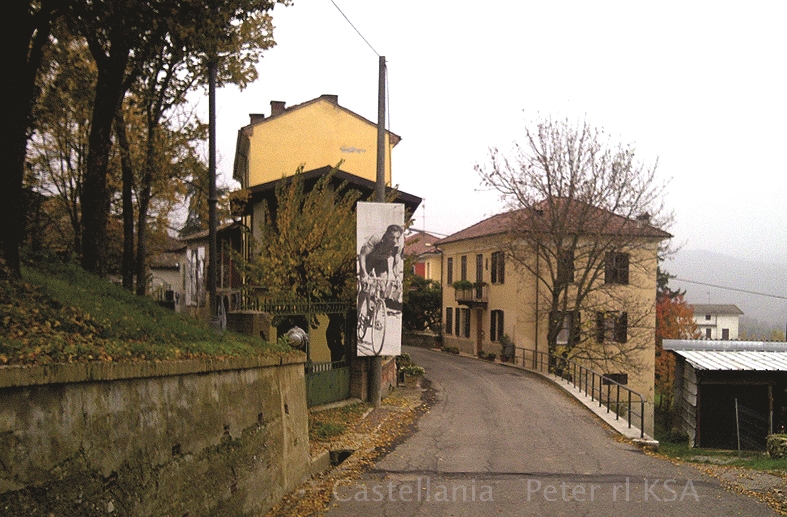
The house where he lived now is open to visitors, still more or less as it looked as the family home. There’s a smart overcoat on a hanger, newspapers from that time are in the room where he slept, and a bicycle too! There’s a tableau in the kitchen of his brother Serse, his blind masseur Biago Cavanna, they’re as friendly a group of riders as you’d find amongst cycling club mates at another’s house today.
The roads around his home town of Castellania don’t make for too-easy cycling. Twists and turns and drops and climbs moulded the local farming family’s boy into the racer who became Campionissimo. Fausto Coppi is still so alive to your presence today, embracing you in the town and places around, the walls and the street signs and the livery in coffee house and cantina hereabouts, they demonstrate a lasting strength and reminder of his will to win and his winning ways.
There is very little that people don’t know about this world revered Italian cycle racer who died in 1960. World Champion, the winner of Giro d’Italia on 8 occasions, the Tour de France twice, the first rider to win both big Tours in the same year, a one hour record holder. These in a riding career split by the 1939-45 war that ravaged Europe and kept people poor. Fausto Coppi didn’t just win races, he dominated social awareness of the time on radio and in the newspapers, on film and at a myriad of cycle races where crowds lined roads six and ten deep to witness history being made. He did it in the smartest possible Brylcreem manner, he impressed and dressed to become the best known sportsman at home in Italy and abroad. That was through a time when Holywood was working so hard to influence populations with cinema screen fantasies, music and adventure.
For the public Fausto Coppi brought the glitter of a film-star. His powerful riding style and this race winner’s fashionable lifestyle was what other riders and racers wanted to emulate. But they couldn’t match him and his matter of fact way with a bicycle. Our reasoning how and why this man endears us so strongly, and the regret that he died when so young, that it is like wondering just how it is that people can actually love cycling. Hard to explain!
On the screen in films, in books and on the pages of a popular comic it is the hero who always wins: Fausto Coppi was born to be nothing less than the cycling hero of all time, the real life person the winner. Campionissimo. Inspiring!
The unique thing about his Castellania and its quiet streets is that the images of the rider we see gracing the place here is pedalling serenely and breathing easily, well at least Fausto Coppi looks to be doing it that way! There is a single picture from the 1952 Tour de France encounter that identifies a world-aware rivalry of two famous racers remembered for coming together to forge epics: Gino Bartali with his countryman Fausto Coppi.
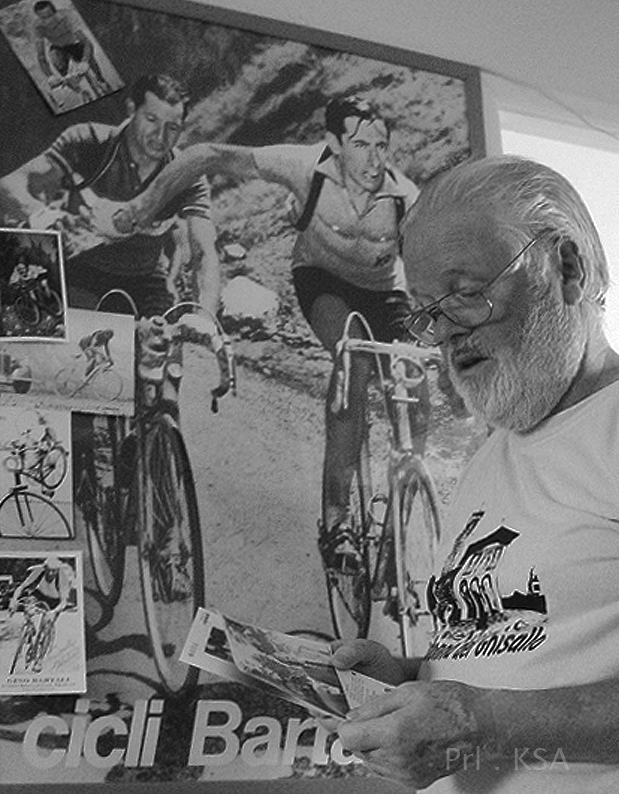
Every day when I go to my writing den at home I pass that famed photo of the shared bidon filling moment, and yes I will again check: Fausto Coppi is passing to Gino Bartali, riding at his right, a glass bottle of water. The bidon tucked in Fausto’s left hand against the handlebar is newly filled – you can see there’s water splashing from the uncorked bidon, which show as flecks of white against the rider’s black race shorts. That’s the picture that has been told with a million words and more by people interpreting the message.
A few years back I met a photographer in Monza who told me his father had organised the Tour de France togetherness session of these two great riders. He told me that Press guys were needing a special picture from a Tour de France day when they didn’t anticipate there would be too much activity in the peleton. So there you have it, one rider in his Yellow Jersey handing a drink to the one who’d previously been there and done it. Gino Bartali was just two years off retirement time, and he was now following his younger combatant’s wheel more often than he’d beat him to the line.
There have been other opinions in the questioning of how it all happened, of course, and one is that this 1952 picture defined the last of the Bartali and Coppi skirmishes: the King is dead, long live the King! Gino Bartali, though, would live on until the year 2000, when after a by-pass operation he would die of a heart attack. There are seen political overtones of that picture too, Fausto Coppi winning the French tour in 1949 and now 1952 was signalling the end of bad blood between nations in Europe; others suggested that these two Italian giants of cycling and their own country, were celebrating together a more unified Italy, their homeland.
For me, I must add that the Gino Bartali signature he put to that picture, and the word amigo he added to the inscription, harks me back to an Italy and the people there I so dearly love. I am equally endeared to photos of Fausto Coppi from when I saw him race at Herne Hill in London. This wasn’t the ultra-fit, so full of energy Italian rider of earlier years but a winner’s garland there was, to lift our hearts and intensify the shared excitement of having seen the Campionissimo riding his bicycle on our English patch. No dream, it happened and I was there.
When I was in Castellania we talked about how the Giro d’Italia could bring the whole world onto the streets in this quiet little place, and to where the Campionissimo had forged his art. The several days I spent there stay as bright memories of a peaceful countryside that delivers so easily redeemable pleasures you can take at you own pace. If it suits you to rush the road, then where else can you imagine your riding companion as one of the greatest champions of all time, you can follow signed routes that pass coffee stops with fingerposts pointing towards the next turn. The tourist may not want to rush, in which case there is no great distance between any of the towns for accommodation to suit your style or where to pitch your camping home. There’s off road cycling hereabouts, the rambler following tracks where it’s easy to spot the wildlife. I found it serenely quiet, so moodingly inviting as the sun burnt away the morning mist across a countryside of flats and folds and dips.
You’ll always want to go back!
Peter rl – a Burnham Boy
PS. In 1952 the Tour de France was won by Fausto Coppi, which inspired us to go for it as bicycle riders. In 1953 Crouch Cycling Club began wheeling about. That Burnham club was renamed by buddy Steve Cruse ten years later as Maldon & District CC. This was where young teenager Alex Dowsett began his cycle racing career. Champion he would become many times, British, World titles too. He would win two stages of the Giro d’Italia and when the tv shot following the racing showed MADcc written on the road: wow! the whole world may have wondered, yet how inspiring was that for Essex!